Some words carry weight the moment you hear them. Perdition is one of them. It shows up in old sermons, courtroom dramas, and even movie titles — but most people can’t define it on the spot.
This guide breaks down the perdition Spiritual meaning in plain English, traces its roots in biblical perdition, and explains why the word still matters in 2026.
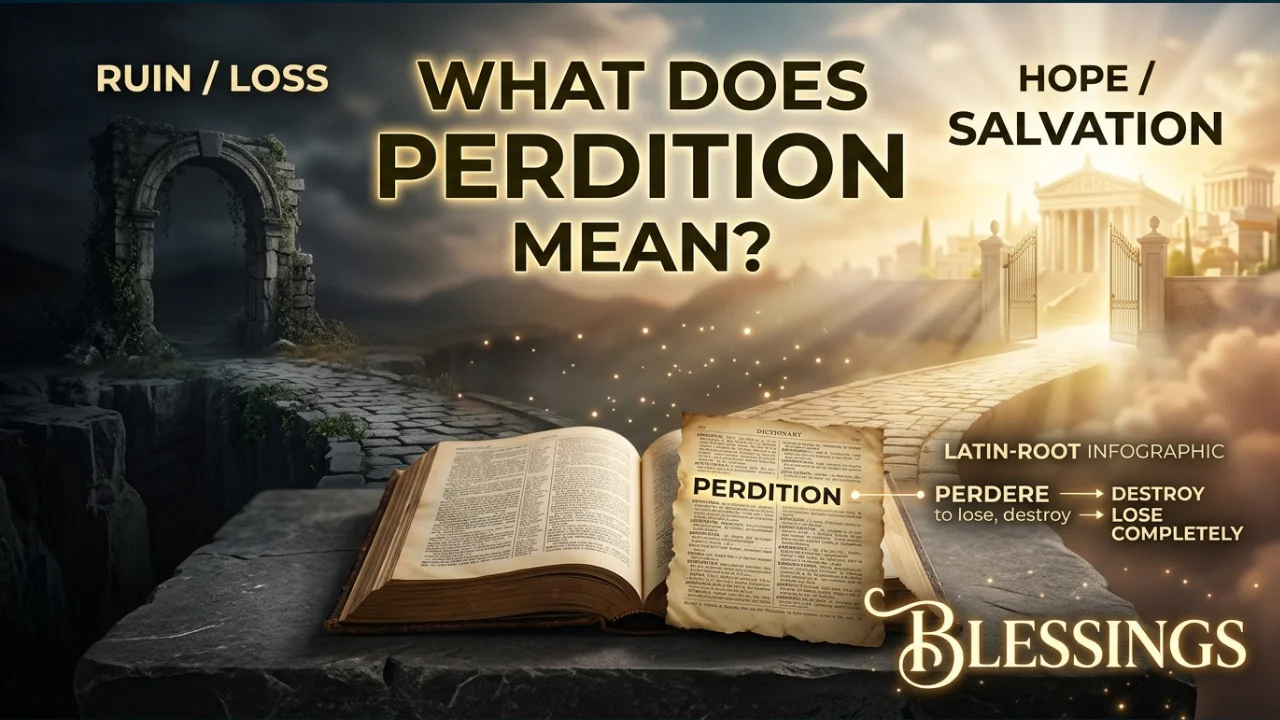
What Does Perdition Mean? Origin and Literal Definition
In simple terms, perdition means eternal punishment or the total, permanent loss of the soul. It’s a formal, uncountable noun — you won’t hear it in casual chat, but you’ll find it in scripture, literature, and theology.
The Oxford Learner’s Dictionary defines it plainly: “punishment that lasts forever after death.” Cambridge Dictionary echoes this, calling it “a state of punishment that goes on forever.”
Word origin matters here. Perdition traces back to the Latin verb perdere, meaning “to destroy” or “to lose completely.” That root traveled through Old French perdiciun before landing in Middle English. The destruction isn’t accidental — it’s baked into the word itself.
Vocabulary.com adds a helpful nuance: while perdition is mainly religious, people also stretch it to describe overwhelming, hellish stress — like juggling three deadlines in one day. That secondary, hyperbolic use doesn’t erase the word’s serious core meaning; it just shows how flexible language can be.
Must Visit:What Does It Mean When a Ladybug Lands on You? Spiritual Meaning & Symbolism
Perdition in the Bible: Scripture, Greek Roots & the “Son of Perdition”
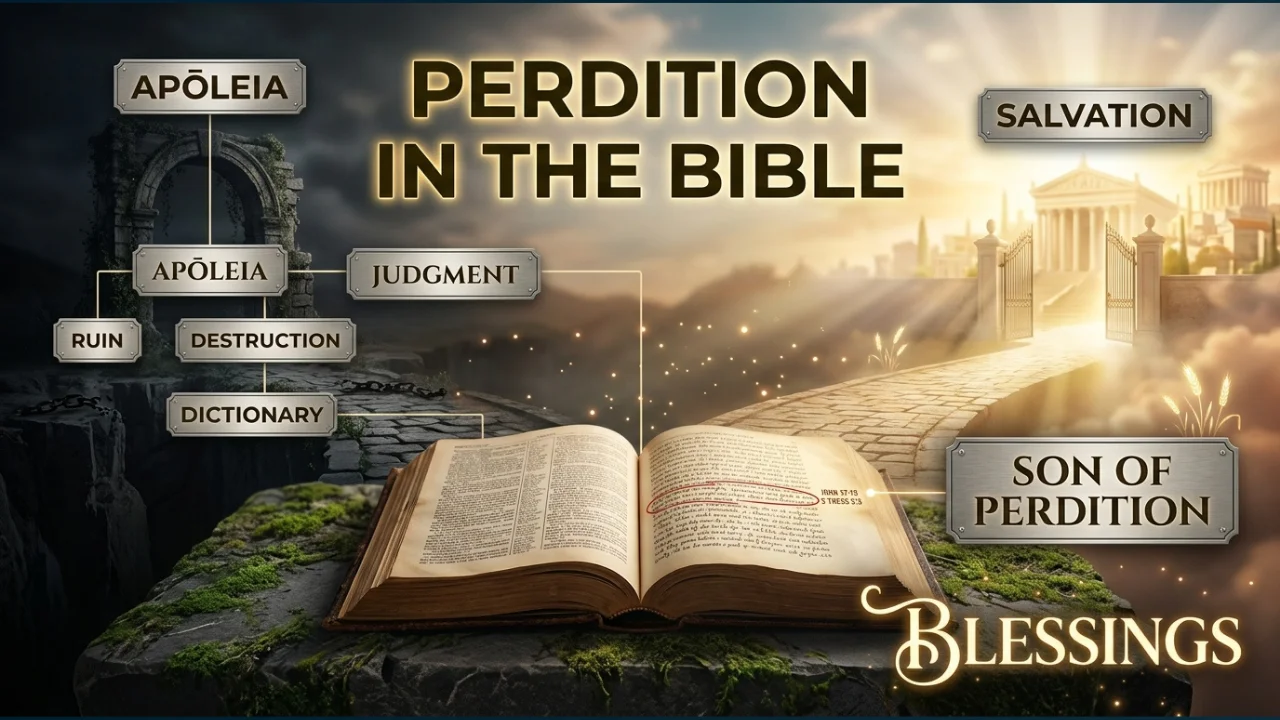
The biblical meaning of perdition runs deeper than a dictionary entry. In the original Greek New Testament, the word translated as “perdition” is apōleia — meaning ruin, destruction, or utter loss. It’s not a soft word. It describes something being wasted beyond recovery.
The Old Testament doesn’t use “perdition” directly, since it predates English. But the concepts of Sheol (the realm of the dead) and Abaddon (destruction personified) carry a similar theological weight, according to Bible Study Tools.
Scripture references worth knowing:
- John 17:12 — Jesus refers to Judas Iscariot as “the son of perdition,” marking him as someone given over entirely to ruin.
- 2 Thessalonians 2:3 — The same phrase, “son of perdition,” reappears here, this time pointing to a future antichrist figure.
- Philippians 1:28 — Perdition is set directly against salvation, framing them as opposite spiritual destinies.
- Revelation 17:8 — A beast is described as ascending “out of the bottomless pit” and going “into perdition.”
- Hebrews 10:39 — Drawing back from faith is linked to perdition, not to a temporary setback.
Bible Study Tools notes that being “lost” in this sense means becoming estranged from God — a state theologians sometimes call spiritual death.
The recurring phrase “son of perdition” isn’t a bloodline term. It’s a Hebrew-style idiom meaning “someone characterized by” — in this case, someone characterized entirely by ruin. Judas Iscariot carries this label because his betrayal of Jesus sealed an irreversible outcome.
The Spiritual Significance of Perdition: Salvation, Judgment & the Soul
Why does this word still matter? Because perdition represents the theological opposite of salvation. Scripture consistently frames the two as a fork in the road — one path toward reconciliation with God, the other toward permanent separation.
This isn’t unique to Christianity. Nearly every major faith tradition has developed its own vocabulary for irreversible spiritual consequence:
- Gehenna in Jewish and early Christian thought
- Jahannam in Islamic theology
- Naraka in Hindu and Buddhist cosmology
The details differ, but the underlying idea repeats across cultures: choices carry eternal weight, and some outcomes cannot be undone. That pattern suggests something important — humans across history have wrestled with the same question of ultimate accountability, even using different words for it.
In practical terms, perdition functions less like a scare tactic and more like a mirror. It asks a person to weigh their choices, their faith, and their direction — not after the fact, but now, while change is still possible.
Perdition vs. Hell vs. Purgatory: Understanding the Differences
These three words get mixed up constantly, so here’s the distinction, stated clearly.
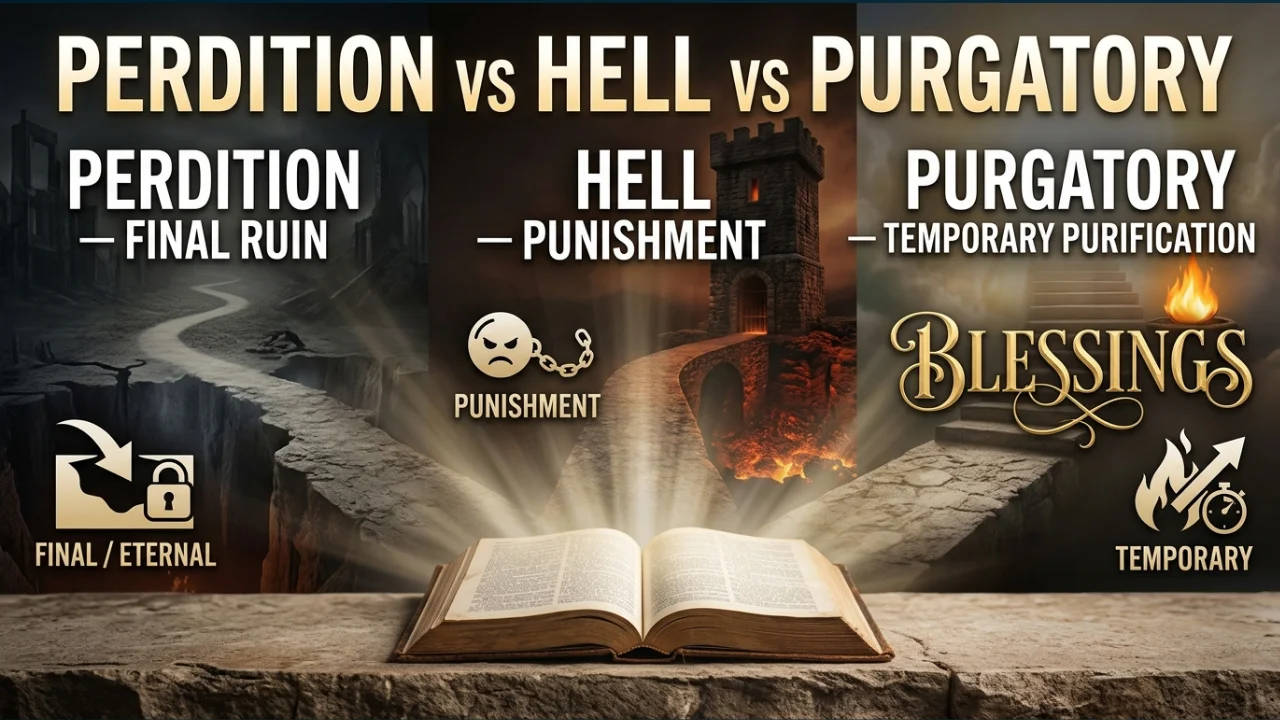
Hell is generally used as the broad term for the place or state of eternal punishment. Perdition describes the condition — total, final ruin — that hell represents. Think of hell as the location and perdition as the fate.
Purgatory is a different concept entirely, and this is where most explanations fall short. In Catholic theology, purgatory is described as a temporary, purifying state — a process of cleansing before entering heaven, not a permanent sentence. Perdition, by contrast, is final and irrevocable. There’s no exit clause.
| Term | Nature | Duration |
|---|---|---|
| Perdition | Total spiritual ruin | Eternal |
| Hell | Place/state of punishment | Eternal |
| Purgatory | Purification process | Temporary |
So no — purgatory and perdition are not the same thing. One is a passage through; the other is a permanent destination.
Perdition in Literature, Culture & Everyday Language
Perdition didn’t stay locked inside theology books. Writers borrowed it centuries ago, and it never left.
John Milton used it in Paradise Lost, describing rebellious angels “hurled headlong… to bottomless perdition.” That single image — a fall with no floor — became one of the most quoted uses of the word in English literature.
The phrase “road to perdition” grew out of this same tradition. It describes a path toward ruin or moral downfall, often used as a warning about the direction someone’s choices are taking them. The phrase gained fresh visibility through the 2002 film Road to Perdition, which used it as a metaphor for a man’s descent into violence and consequence — not a literal reference to hell, but a nod to the same idea of irreversible ruin.
Outside religious or literary contexts, people also use “perdition” loosely to describe overwhelming chaos or stress — a stretch from its original meaning, but a common one.
Example sentences:
- “The preacher warned that a life without repentance leads straight to perdition.”
- “After the scandal broke, his career seemed headed for perdition.”
- “She joked that finals week felt like pure perdition.”
FAQs About Perdition Meaning
What is the literal meaning of perdition?
The literal meaning is total, permanent destruction or ruin — specifically, eternal punishment after death in a religious context. It comes from the Latin perdere, meaning “to destroy completely.”
What does the term road to perdition mean?
“Road to perdition” describes a path leading toward moral or spiritual ruin. It’s used as a warning phrase, suggesting that a person’s current choices or behavior are heading toward a destructive, often irreversible, outcome.
Is purgatory the same as perdition?
No. Purgatory is temporary, described in Catholic theology as a purifying process before heaven. Perdition is final and permanent — a state with no path back. They represent opposite outcomes: one leads forward, the other does not.
How do you use perdition in a sentence?
Use it to describe eternal ruin or, more loosely, extreme hardship: “His refusal to change course seemed to guarantee his perdition,” or casually, “Juggling three jobs at once felt like perdition.”
Final Thoughts
Perdition isn’t just an old-fashioned word for hell — it’s a specific idea about finality, loss, and consequence that has shaped religious thought for centuries. Whether encountered in scripture, Milton’s poetry, or a film title, the word carries the same core warning: some roads don’t lead back.

Malik Sohail is the admin and author of ParensMeaning.com. He researches and writes clear, engaging content about spiritual meanings, symbolism, signs, and interpretations, helping readers understand deeper insights behind everyday experiences.