───────────────────────────────────────────────────────────────────────
You spot a fluttering flash of gold and black in your garden. You pause. You stare. Something about a yellow and black butterfly stops you in your tracks — and there is a very good reason for that.
These are not just pretty insects. They carry real biological wonder, deep symbolic Spiritual meaning, and a story most people have never heard. This guide covers everything — from species ID to spiritual significance — the kind of depth you will not find anywhere else.
────────────────────────────────────────────────────────────────────────
What Are Yellow and Black Butterflies? (Species Overview)
Not every yellow and black butterfly you see is the same species. In the USA alone, several distinct swallowtail butterfly species share this bold color pattern. Knowing the difference matters.
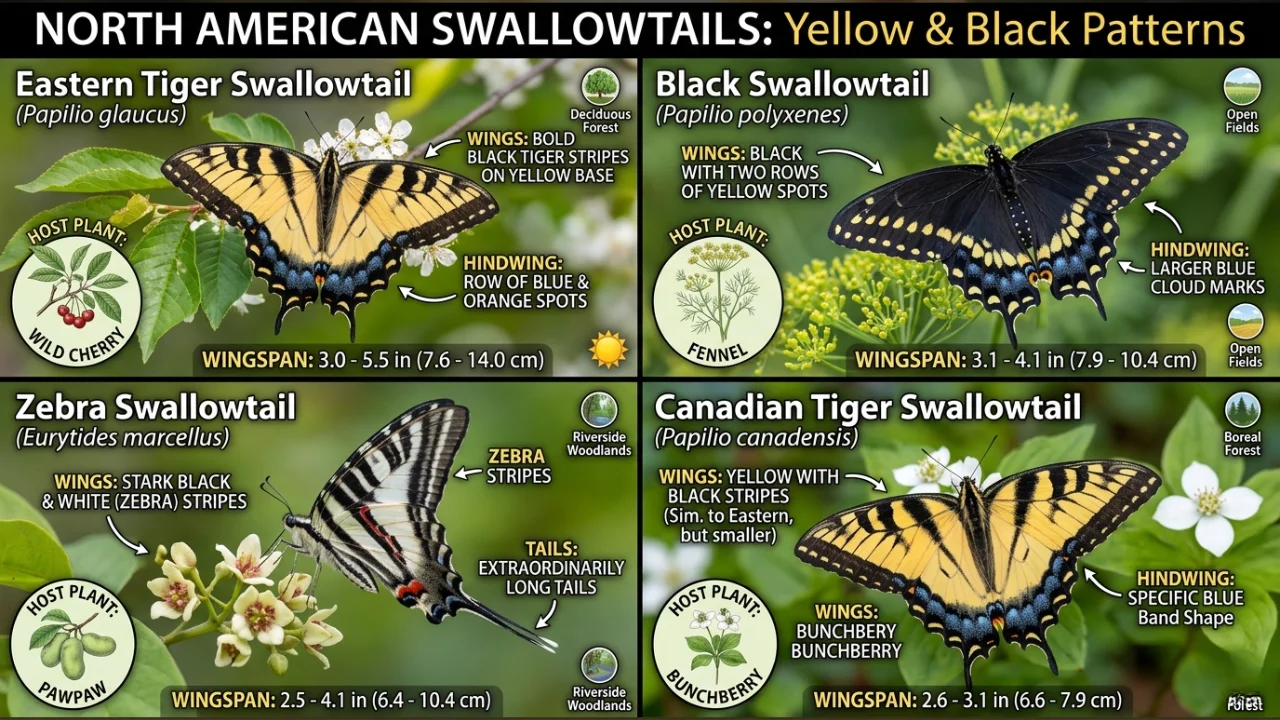
Eastern Tiger Swallowtail — America’s Most Familiar Yellow Black Butterfly
The Eastern Tiger Swallowtail (Papilio glaucus) is the most widely recognized yellow and black butterfly in North America.
It wears bold black vertical stripes across bright yellow wings — like a tiger in flight. Males are consistently yellow. Females come in two forms: a yellow version similar to the male, and a striking dark form that mimics the toxic Pipevine Swallowtail to fool predators. This survival trick is called Batesian mimicry.
�� Expert Fact: The Eastern Tiger Swallowtail is the official state butterfly of Alabama, Delaware, Georgia, North Carolina, South Carolina, and Virginia.
Black Swallowtail — The Spotted Beauty With a Secret
The Black Swallowtail is primarily black but carries rows of yellow spots and a vivid blue iridescent patch on the hindwings — especially bright on females. Males show a stronger yellow band across the wings.
What competitors rarely mention: its caterpillars feed on the carrot family (Apiaceae) — plants like parsley, dill, fennel, and Queen Anne’s lace. If you grow herbs, you’ve likely already hosted one.
Must Visit:Duckling Spiritual Meaning: 10 Powerful Messages from Nature’s Smallest Teachers
Canadian Tiger Swallowtail — The Northern Flyer
Closely related to the Eastern Tiger Swallowtail, the Canadian Tiger Swallowtail is smaller, found farther north, and prefers cooler climates — New England, the Great Lakes, and into Canada.
Its flight period typically runs from late May through early July, peaking in mid-June. Host plants include birch, aspen, and black cherry.
Zebra Swallowtail — Rare, Distinctive & Overlooked
The Zebra Swallowtail is instantly recognizable — striking black-and-white stripes, long elegant tails, and a red spot near the base of the hindwing. It is found mainly in the eastern US and depends almost entirely on pawpaw trees (Asimina triloba) as its larval host plant.
Because pawpaw trees are declining in many regions, the Zebra Swallowtail is considered uncommon to rare in parts of its range. Spotting one is a genuine treat.
Palamedes Swallowtail — The Southern Cousin
Mostly seen along the Gulf Coast and southeastern US, the Palamedes Swallowtail is larger and browner than the Black Swallowtail. A quick ID tip: it has a striped body where the Black Swallowtail has a spotted body. Its primary larval host is the Red Bay tree.
Spicebush Swallowtail — The Look-Alike
Predominantly black with pale blue-green spots, the Spicebush Swallowtail is often mistaken for the dark-form female Eastern Tiger Swallowtail. Its young caterpillars mimic bird droppings — nature’s cleverest disguise. As they mature, they develop snake-like eyespots on the thorax. Host plant: spicebush (Lindera benzoin).
────────────────────────────────────────────────────────────────────────
How to Identify Yellow & Black Butterflies (Wing Patterns, Size & Markings)
Misidentifying a butterfly is easy. But once you know what to look for, it becomes second nature. Here’s what to check.
Wing Color Patterns — Stripes, Spots & Blue Patches Explained
The most reliable ID tool is the wing pattern.
Eastern Tiger Swallowtail: Vertical black stripes on yellow wings. Bold and symmetrical.
Black Swallowtail: Double rows of yellow spots. Blue iridescence on female hindwings.
Zebra Swallowtail: Alternating black and white stripes. Long, elegant tails.
Palamedes Swallowtail: Yellow stripe fused into a bar near the base of the hindwing.
Male vs. Female — Key Differences You Should Know
In most swallowtail species, sexual dimorphism — visible differences between males and females — is easy to spot.
Male Eastern Tiger Swallowtail: Bright yellow. No blue band on hindwings.
Female Eastern Tiger Swallowtail: Yellow or dark form. Prominent blue band on hindwings.
Male Black Swallowtail: Wider yellow band.
Female Black Swallowtail: Smaller yellow markings, larger and richer blue patches.
Size Guide — So You Never Confuse Them Again
Size is a fast and reliable field marker:
Black Swallowtail: 3.5 inches wingspan
Palamedes Swallowtail: 4–4.5 inches wingspan
Eastern Tiger Swallowtail: Up to 5.5 inches wingspan
Giant Swallowtail: 4.5–5.5 inches — the largest butterfly in North America
�� Quick ID Tip: If the butterfly is mostly yellow underneath with large stripes on top — it’s almost certainly a Giant Swallowtail. Nothing else looks quite like it.
────────────────────────────────────────────────────────────────────────
Yellow & Black Butterfly Meaning — A Magical Sign of Growth
Beyond biology, people across the USA have long connected yellow and black butterflies with deeper meaning. And in 2025, that symbolism feels more relevant than ever.
What Does It Mean When You See a Yellow and Black Butterfly?
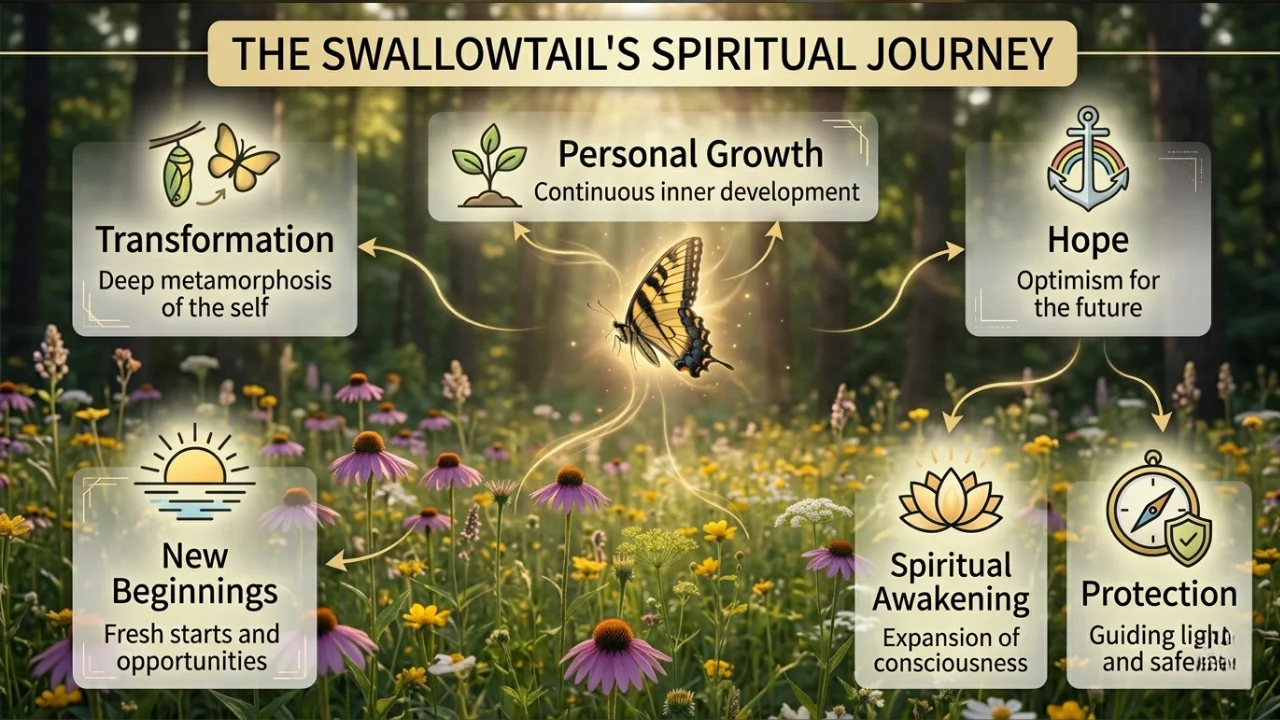
A yellow butterfly is widely associated with joy, hope, new beginnings, and spiritual transformation. The color yellow has long symbolized optimism and mental clarity in American culture.
When black is combined with yellow, the meaning deepens. Black in nature often signals protection, power, and the unknown. Together, the yellow-black combination is interpreted as a sign of personal growth emerging from a period of challenge.
Many people report seeing a yellow and black butterfly during major life transitions — a new job, a loss, a move, or a turning point. Whether or not you assign spiritual meaning, the timing is often hard to ignore.
Spiritual & Cultural Meaning Across American Traditions
In ancient Greek tradition, the word “Psyche” meant both butterfly and human soul. The Greeks depicted the soul as a young woman with butterfly wings — a concept that still echoes today.
Among several Native American traditions, butterflies carry messages from ancestors and signal answered prayers. A butterfly crossing your path is rarely dismissed as coincidence.
In modern spiritual communities across the USA, a yellow butterfly sighting is interpreted as a signal to trust your path and embrace change. The black markings are seen as grounding — reminding you that growth requires contrast.
Why 2025 Makes the Yellow Butterfly Symbol More Powerful Than Ever
In 2025, butterfly symbolism is seeing a cultural resurgence. Interest in nature-based mindfulness, backyard ecology, and biophilic design has surged across the US. People are paying closer attention to what lives around them — and butterflies are among the first things they notice.
The yellow and black butterfly has become a symbol not just of personal growth, but of environmental awareness and the fragility of pollinators. When you see one, you’re witnessing something increasingly precious.
────────────────────────────────────────────────────────────────────────
Life Cycle of Yellow & Black Butterflies — From Egg to Wings
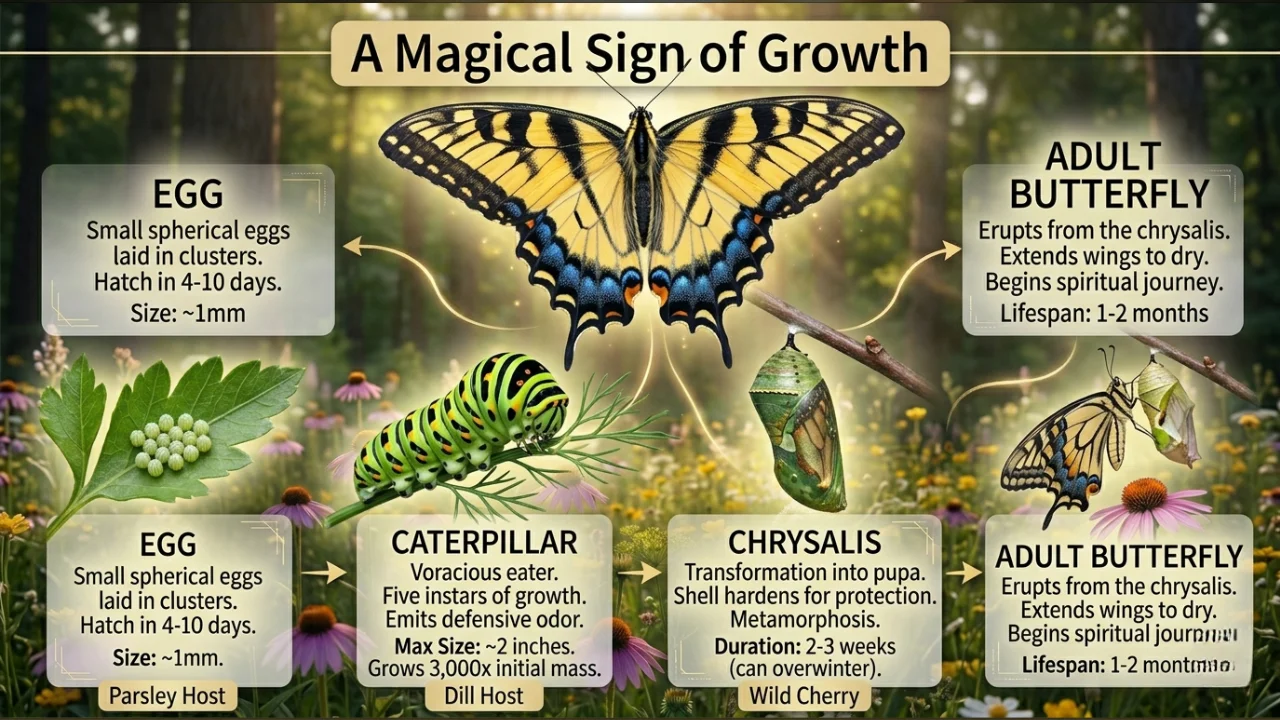
This is the section most competitor blogs skip entirely — or barely touch. The butterfly life cycle is one of nature’s most dramatic stories. Here’s the full picture.
Egg Stage — Laid Singly on Host Plants
Female swallowtails lay their eggs one at a time directly on host plant leaves. The Eastern Tiger Swallowtail chooses wild cherry, tulip poplar, and sweet bay. The Black Swallowtail prefers plants in the carrot family — parsley, fennel, dill, and carrots.
Eggs are tiny and round — often greenish or pale yellow. They hatch within 3–7 days depending on temperature.
Caterpillar & Larval Instars — Nature’s Most Dramatic Transformation
After hatching, the caterpillar — the larva — eats constantly and grows through a series of stages called instars. Most swallowtails pass through five instars.
Early instars look like bird droppings — dark with a white saddle patch. This is deliberate camouflage. As the caterpillar matures, it shifts to bright green with yellow-spotted black bands — the iconic “caterpillar look” most people recognize.
When threatened, the caterpillar deploys an organ called the osmeterium — a forked, bright orange gland that releases a foul smell to deter predators. Most people have never heard of this. It looks almost snake-like when extended.
Chrysalis to Eclosion — The Metamorphosis Moment
The caterpillar forms a chrysalis — not a cocoon (that’s moths). Inside, a process called holometabolism breaks down the larval body and rebuilds it entirely into a butterfly. Scientists still do not fully understand all mechanisms involved.
Many swallowtails overwinter in the chrysalis stage — a process called diapause. When conditions are right, the butterfly ecloses — emerges — and rapidly inflates its wings using fluid pumped through the wing veins. It “zips” its proboscis together and is ready to fly within hours.
────────────────────────────────────────────────────────────────────────
Where to Find & How to Attract Yellow Black Butterflies in the USA
The good news: you don’t need to travel far. Many yellow and black butterfly species live right in or near suburban neighborhoods across the US.
Preferred Habitats — Where They Live
Yellow and black butterflies thrive in specific environments:
Open fields and meadows — especially with wildflowers
Forest edges — where sunlight meets shade
Stream banks and river corridors — moisture attracts nectar plants
Suburban gardens — particularly those with native flowering plants
Marsh edges — especially in the southeastern US
Best Host Plants & Nectar Plants to Grow
Want to attract swallowtails to your yard? Plant both host plants (for caterpillars) and nectar plants (for adults).
Top Host Plants:
Wild cherry · Tulip poplar · Parsley · Fennel · Dill · Spicebush · Pawpaw · Birch · Aspen
Top Nectar Plants:
Milkweed · Lantana · Coneflower (Echinacea) · Lilac · Thistle · Wild iris · Joe Pye weed · Clovers
�� Pro Tip: The North American Butterfly Association (NABA) certifies butterfly gardens. Plant even a small patch of the above and you’ll see results within one season.
Seasonal Flight Periods by US Region — What Competitors Miss
This is rarely covered in detail — but it’s critically useful:
Southeast USA: Black Swallowtails and Palamedes active nearly year-round
Northeast USA: Eastern Tiger Swallowtail peaks May through September
Midwest USA: Black Swallowtail most active June through August
Pacific Northwest: Western Tiger Swallowtail replaces the Eastern counterpart; peaks June–July
Northern states / Canada border: Canadian Tiger Swallowtail peaks mid-June
────────────────────────────────────────────────────────────────────────
FAQS
Q: What are the black and yellow butterflies called?
A: The most common black and yellow butterflies in the USA are Eastern Tiger Swallowtail, Black Swallowtail, Canadian Tiger Swallowtail, Zebra Swallowtail, and Palamedes Swallowtail. All belong to the family Papilionidae. The Eastern Tiger Swallowtail (Papilio glaucus) is the most widely recognized.
Q: What does it mean if you see a yellow and black butterfly?
A: Across many American and global traditions, a yellow and black butterfly symbolizes personal growth, transformation, hope, and new beginnings. Yellow represents joy and optimism; black adds depth and protection. Many people report sightings during major life transitions. Scientifically, you’re likely witnessing a healthy pollinator ecosystem — which is a very good sign in itself.
Q: Which animal has 4,000 muscles?
A: The caterpillar — the larval stage of a butterfly or moth — has approximately 4,000 muscles in its body. For comparison, humans have around 629. This extraordinary muscle density allows caterpillars to move, eat, and navigate with remarkable precision despite their small size.
Q: Is a Zebra Swallowtail rare?
A: The Zebra Swallowtail is considered uncommon to rare across much of its range in the eastern United States. Its survival depends almost entirely on pawpaw trees (Asimina triloba) as a larval host. As pawpaw habitat declines, so does the butterfly. Spotting one is genuinely exciting for any naturalist.
────────────────────────────────────────────────────────────────────────
Final Thoughts
A yellow and black butterfly is never just a butterfly. It’s a living symbol of transformation — one that has completed one of nature’s most complex journeys just to flutter past you.
Whether you’re drawn to the science, the symbolism, or simply the beauty — these creatures deserve a second look. And now you know exactly what you’re seeing.

Malik Sohail is the admin and author of ParensMeaning.com. He researches and writes clear, engaging content about spiritual meanings, symbolism, signs, and interpretations, helping readers understand deeper insights behind everyday experiences.