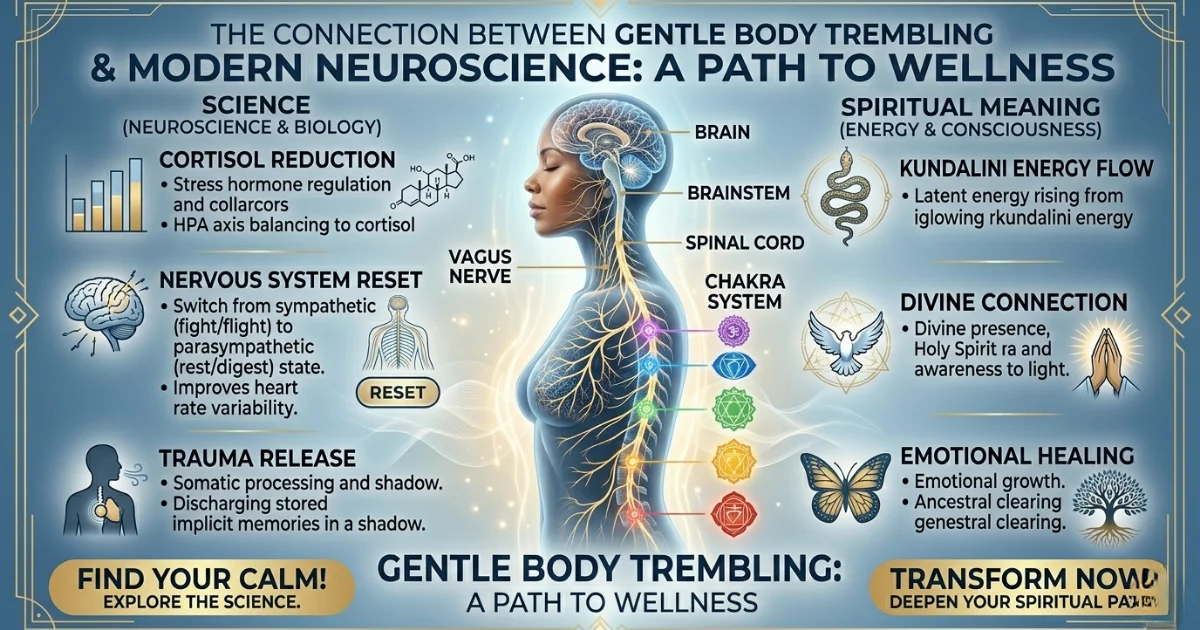
This happens to more people than you think. And in most cases, it is not random. Body shaking spiritual meaning goes far deeper than a simple physical reaction. It is your body responding to energy, emotion, and divine presence in ways your mind is still catching up to.
This guide breaks down all 10 body-shaking spiritual meanings in 2025 — what they are, why they happen, what ancient traditions say, what modern science confirms, and what you should actually do when it happens to you.
What Is Body Shaking Spiritual Meaning — And Why It Happens
Spiritual shaking is when your body trembles, vibrates, or moves involuntarily during — or after — a deep spiritual, emotional, or energetic experience.
It is different from medical tremors. It usually comes during meditation, prayer, energy healing, grief, or moments of profound inner shift.
Think of it this way. Your body is like a radio receiver. When a new, stronger signal comes through, the antenna vibrates. Spiritual trembling is your physical form adjusting to a signal your soul is already receiving.
This is not a modern idea. Ancient traditions across the world — from Kundalini yoga in India to Seiki Jutsu in Japan to Biblical Pentecost in Christianity — have all recognized body shaking as sacred.
And now, modern science is starting to agree. Researchers studying neurogenic tremoring — the body’s built-in mechanism to release deep muscular tension — confirm that involuntary shaking is the nervous system’s natural reset tool.
The two explanations are not opposites. They are the same truth seen from different angles.
The 10 Body-Shaking Spiritual Meanings You Need to Know
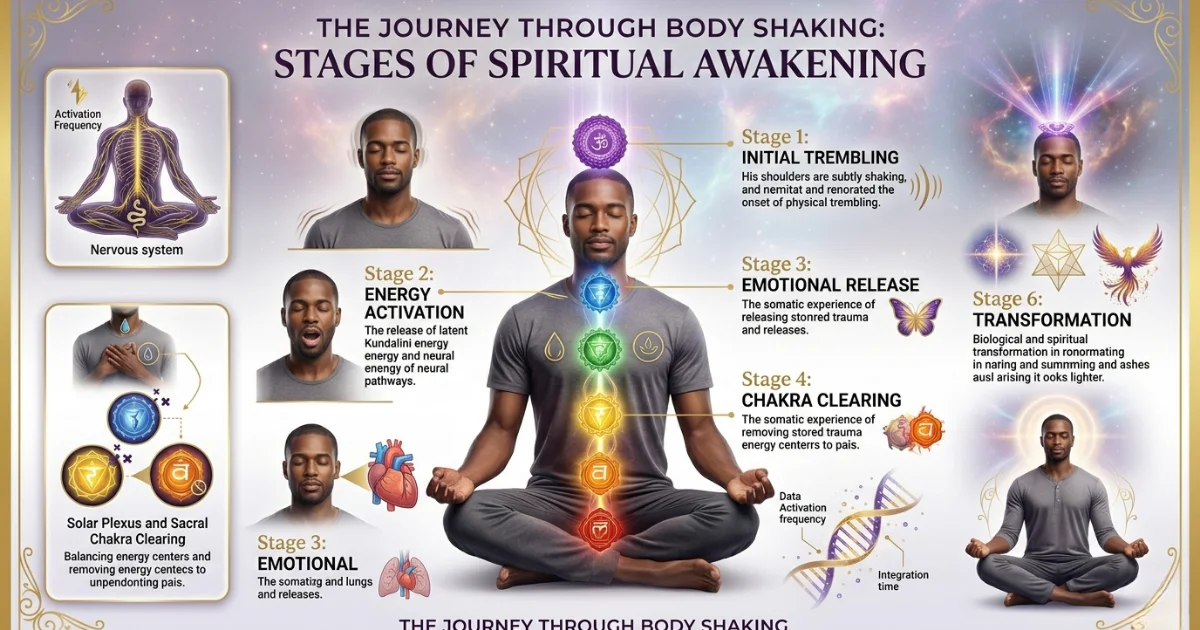
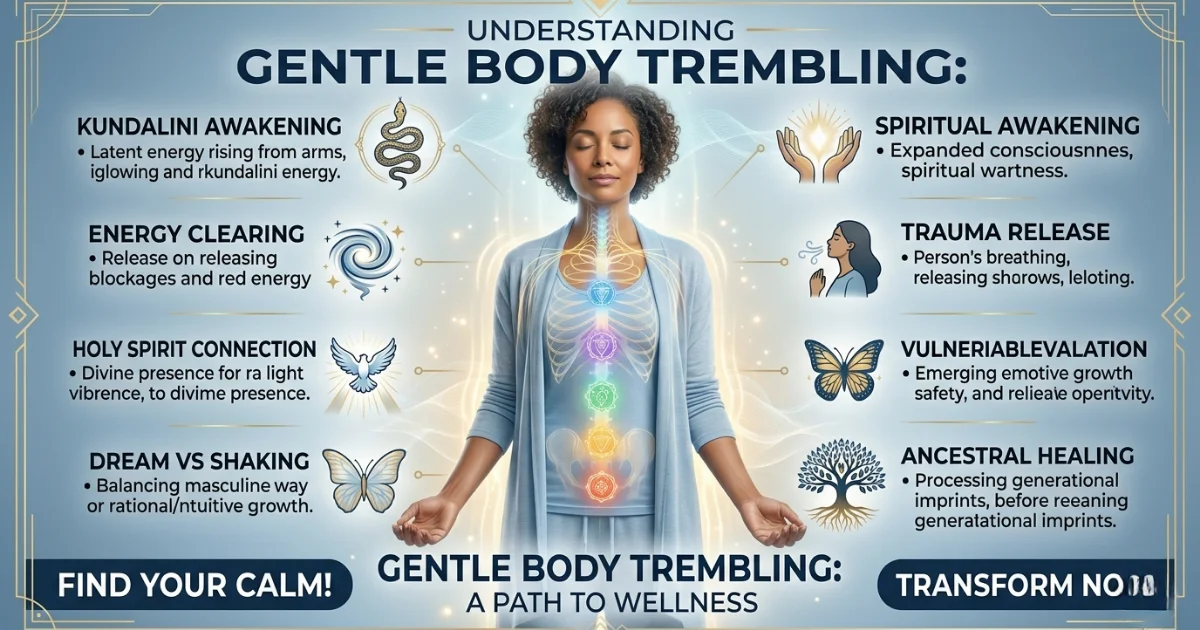
Kundalini Awakening — When Energy Rises Through the Spine
Kundalini awakening is one of the most well-documented causes of spiritual body shaking.
Kundalini is described in yogic tradition as a coiled energy sitting at the base of the spine. When it rises, it travels upward through the spinal column, activating each energy center along the way.
As it moves, the spine literally shakes.
Spiritual teacher A.H. Almaas, founder of the Diamond Approach, described his first encounter with Brilliancy — a state of powerful expanded presence — like this: he was standing in a room with others and his body began shaking for no apparent reason. He stayed with it. And then an immense, luminous presence arrived.
That is what Kundalini rising symptoms often feel like. The shaking comes first. The presence follows.
If your spine, lower back, or whole body trembles during or after meditation — Kundalini activation is worth understanding.
Spiritual Awakening — Your Soul’s Alarm Clock Going Off
A spiritual awakening does not always look peaceful. Sometimes it looks like full-body trembling at 3 AM with no explanation.
During awakening, your vibrational frequency shifts. Your consciousness is expanding beyond the beliefs, identities, and emotional patterns it has operated within for years.
That expansion has a physical cost. The body shakes because it is reorganizing itself around a new energetic reality.
This is classified in Vaishnavism as one of the sattvika-bhavas — involuntary physical expressions that arise from deep divine emotional engagement. Ancient Hindu texts in the Bhakti-rasamrta-sindhu list trembling alongside hair standing on end, weeping, and paralysis — all as signs of the soul touching something real.
A spiritual awakening shake tends to feel awe-filled, even if it is also frightening.
Must Visit: Open eyes meaning: A Journey into Spiritual Sleep Mysteries in 2026
Energy Purification and Clearing Energetic Blockages
Your body stores more than muscle memory. It stores energetic blockages — compressed emotion, unprocessed experience, inherited tension — lodged in tissue, fascia, and the energy field surrounding the body.
When purification begins — through deep meditation, breathwork, sound healing, or prayer — these stored energies begin to move.
And moving energy shakes the body.
This connects directly to chakra alignment. As blockages clear from the root chakra upward, different regions of the body may tremble. A shaking solar plexus often signals releasing old power struggles. A trembling heart center often signals grief or love breaking open.
The shake is not the problem. It is the release of the problem.
Emotional and Trauma Release — What TRE and Ancient Wisdom Both Confirm
This is the area where science and spirituality align most clearly — and where most competing blogs fail to connect the dots.
TRE — Tension and Trauma Releasing Exercises — is a body-based therapy developed by Dr. David Berceli. It deliberately activates the body’s natural tremoring mechanism to release deep stress and trauma stored in the muscles.
The results? Profound nervous system regulation. Reduced anxiety. Emotional release. Inner calm.
Now here is what is remarkable: ancient spiritual traditions have been doing this for centuries.
A 2016 study published in the International Journal of Yoga found that participants practicing Osho Dynamic Meditation — which includes intentional full-body shaking — showed significant reductions in cortisol levels after 21 days.
Cortisol is your primary stress hormone. Lower cortisol means a calmer hypothalamus-pituitary-adrenal (HPA) axis — the body’s central stress-response system.
When you shake, you are not falling apart. You are chemically and energetically resetting.
Divine Connection — Shaking Under the Holy Spirit’s Power
For millions of Christians across the USA, shaking under the Holy Spirit is a well-known and deeply personal experience.
It is not performance. It is not emotionalism. It is the physical body responding to an encounter with divine energy that is far larger than the body can contain quietly.
Biblical accounts confirm this pattern repeatedly:
- Daniel trembled and fell to the ground during his visions (Daniel 10:8-10)
- Moses’ body reacted physically in the divine presence
- At Pentecost, the gathered disciples experienced powerful, overwhelming spiritual manifestations
When the Holy Spirit moves through a person, the body often responds with trembling, rhythmic shaking, or falling. This is described in Charismatic and Pentecostal traditions as shaking under the anointing — a sign of surrender and sacred alignment.
The body is simply being honest about what the spirit is experiencing.
Ancestral Healing — Releasing Generational Wounds Through the Body
This meaning is almost entirely absent from competing blogs. That makes it one of the most valuable things you will read here.
Ancestral healing refers to the resolution of trauma, belief patterns, and karmic imprints passed down through your family lineage — not just through behavior, but through the body itself.
Epigenetics research, including landmark studies from Emory University, has shown that trauma can be transmitted across generations through changes in gene expression. Your nervous system may be carrying tension that is not entirely yours.
When the body shakes during deep spiritual or somatic work, it can signal that generational wounds are being processed and released — patterns that your grandparents or great-grandparents never had the tools to resolve.
You may be shaking free what your ancestors could not.
This is one of the most profound — and least discussed — dimensions of spiritual body trembling.
Vulnerability and Defenselessness — When Inner Walls Come Down
A.H. Almaas, in his teaching The Unfolding Now, describes something that most spiritual blogs never touch.
He explains that when our inner defenses begin to dissolve — the psychological walls we build to protect ourselves from pain — the body enters a state of trembling vulnerability.
This trembling is not weakness. It is openness.
As the walls come down, we feel exposed. Unprotected. Delicate. The body shakes because it is standing in a new territory without its old armor.
He writes that this trembling is the heart becoming more real — more capable of intimacy, presence, and genuine contact with life.
If your body shakes when you are emotionally raw or open — this is your being dropping its defenses. That is profound progress, not something to fear.
This psychological-spiritual angle is completely missing from every competing article on this topic.
Transformation — Your Body Upgrading Its Spiritual Software
Think of spiritual transformation like a software update on a device.
During the update, the system slows down. It gets warm. It behaves unusually. But when the update completes, it runs better than before.
Body shaking during transformation follows the same pattern. Your physical form is integrating new vibrational frequencies — higher states of consciousness, new emotional capacities, expanded spiritual awareness.
This manifests as rhythmic shaking, temperature fluctuations, tingling through the limbs, and waves of energy moving through the torso.
Old patterns — limiting beliefs, habitual emotional responses, outdated identities — are being cleared to make room for the upgraded version of you.
The shake is the installation process. Trust it.
Revelation and Dream-State Shaking — Receiving Spiritual Downloads
Shaking in sleep spiritual meaning is one of the most searched questions on this topic — and one of the least thoroughly answered.
When your body shakes during sleep or in the hypnagogic state (the edge between waking and sleeping), it often signals one of two things:
Astral experiences — your consciousness is moving beyond the physical body, and the shake is the departure or return point.
Prophetic downloads — your spirit is receiving information, guidance, or revelation from a higher source. The physical body trembles as the frequency of that information passes through.
Many people wake from these experiences with a deep sense of knowing — a clarity or direction they did not have before.
Keep a journal beside your bed. What you receive in these shaking states can be profoundly instructive for your waking life.
Right-Hand vs. Left-Hand Shaking — What the Side of Your Body Reveals
Not all shaking is the same. Where your body shakes carries its own message.
| Type of Shaking | Spiritual Significance | Energy Center |
|---|---|---|
| Right-hand tremors | Future guidance, new action, divine direction | Solar Plexus Chakra |
| Left-hand shaking | Past healing, intuition, emotional integration | Heart Chakra |
| Full-body trembling | Kundalini awakening, total energetic shift | All Chakras |
| Shaking during sleep | Astral experiences, divine downloads | Crown Chakra |
| Spinal shaking | Kundalini rising, space manifesting in consciousness | Central channel |
Right-hand shaking spiritual meaning generally points forward — new opportunities, divine direction, solar plexus activation.
Left-hand shaking points inward and backward — healing the past, deepening intuition, opening the heart.
Full-body trembling is the most complete signal. Every chakra is engaged. Something large is moving through you.
The Science Behind Spiritual Shaking — Nervous System, Vagus Nerve, and Beyond
Most blogs cover either the spiritual side or the scientific side. Very few cover both with accuracy. Here is what the research actually shows.
The vagus nerve is the longest nerve in the body. It runs from the brainstem through the heart, lungs, and gut. It is the primary communication highway between body and brain.
When you shake — voluntarily or involuntarily — the vagus nerve sends a signal to the brain that says: the threat has passed. Stand down.
This triggers the parasympathetic nervous system — the rest-and-digest mode — to activate. Heart rate slows. Breathing deepens. Muscles soften.
This is why people often feel profoundly calm after a shaking episode.
The HPA axis — the hypothalamus-pituitary-adrenal system that governs your stress response — also begins to quiet. Cortisol drops. The body stops producing stress hormones it no longer needs.
Robert Sapolsky, author of Why Zebras Don’t Get Ulcers, observed that animals in the wild shake vigorously after surviving a predator encounter. This shaking completes the stress cycle and prevents trauma from locking into the body.
Humans have the same mechanism. We just spend years overriding it with social conditioning.
Practices like TRE (Tension and Trauma Releasing Exercises), Osho’s Kundalini Meditation, and Waidangong — China’s 2,000-year-old finger-and-toe flexing practice — all work with this same biological truth.
Must Visit: Open eyes meaning: A Journey into Spiritual Sleep Mysteries in 2026
Ancient Traditions That Recognized Body Shaking as Sacred
Long before neuroscience had language for it, ancient cultures knew that shaking was holy.
Osho’s Kundalini Meditation — perhaps the most famous modern shaking practice — involves one hour of practice beginning with full-body shaking. Osho described it as a way to “melt the rocklike being, wherever the energy flow has been repressed and blocked.” The shaking dismantles rigidity before stillness can be found.
Waidangong is a Chinese practice over 2,000 years old. It induces a trembling response through rhythmic flexing of the fingers and toes, stimulating energy flow through the meridian system.
Seiki Jutsu, a Japanese healing art, is sometimes called shaking medicine. Practitioners believe that inducing specific tremors rebalances the body’s life-force energy.
In Vaishnavism, the Bhakti-rasamrta-sindhu classifies involuntary body shaking as one of the sattvika-bhavas — physical expressions arising from authentic divine emotional states, particularly within shanta-rasa (the devotional mood of peaceful transcendence).
The Yoga Sutras, interpreted through Bhoja’s Rajamartanda, note that body shaking can arise during deep yogic practice — specifically as energy moves through and temporarily destabilizes posture before a deeper stillness settles.
Every tradition, every continent, every era — they all arrived at the same recognition. The shaking body is a body in contact with something real.
How to Respond When Your Body Shakes Spiritually
Most blogs explain what the shaking means. Almost none tell you what to actually do. This section fills that gap.
Do not suppress it. Social conditioning teaches us that shaking is embarrassing or alarming. That conditioning keeps us trapped in a loop of unresolved tension. When shaking arises in a safe context, allow it.
Breathe consciously. Slow, deep breaths through the nose signal safety to the nervous system and support the vagus nerve in completing the release cycle.
Stay grounded. Feel your feet on the floor. Place a hand on your heart. Speak aloud: “I am safe. This is a release.” Grounding prevents the shaking from becoming overwhelming.
Journal after the experience. Write what you felt, where in the body the shaking was strongest, what emotions or images arose. Over time, patterns will emerge that give you clearer insight into your spiritual and emotional process.
Seek professional support when needed. If shaking is frequent, intense, or connected to trauma, work with a somatic therapist or a TRE practitioner alongside your spiritual practice. Shaking is powerful. Skilled support makes it safer.
Build a safe container. Before intentional shaking practices — breathwork, Kundalini meditation, TRE — set a clear intention. Create a quiet space. Give yourself time to integrate afterward.
The body is wise. Your job is to create the conditions where its wisdom can move freely.
FAQs
What does it mean when your body shakes spiritually?
When your body shakes spiritually, it means your physical form is responding to a shift in energy, consciousness, or emotional state. It can signal Kundalini awakening, divine presence, trauma release, energetic purification, or a spiritual transformation in progress. The body shakes because it is processing something larger than ordinary thought or emotion — something that moves through the whole nervous system.
What are the 7 signs of a spiritual awakening?
The seven most recognized signs of a spiritual awakening are: (1) unexplained physical sensations including trembling or tingling, (2) a sudden shift in what matters to you, (3) heightened sensitivity to energy and emotion, (4) disrupted sleep and vivid dreams, (5) a deepening desire for truth over comfort, (6) a feeling of the old self dissolving, and (7) moments of profound peace or presence that arise without reason. Body shaking often appears alongside several of these signs simultaneously.
Can the Holy Spirit make your body shake?
Yes. Across Christian traditions — particularly Charismatic, Pentecostal, and evangelical communities — shaking under the Holy Spirit is a well-documented phenomenon. When divine energy moves through a person during prayer, worship, or ministry, the physical body often responds with trembling, falling, or rhythmic shaking. This is called shaking under the anointing and is seen as a sign of surrender to divine presence. Biblical precedents include Daniel, Moses, and the disciples at Pentecost.
What is spiritual shaking?
Spiritual shaking is involuntary or semi-voluntary trembling of the body that occurs during or following a spiritual, energetic, or deeply emotional experience. It is recognized across traditions — Hindu, Christian, Japanese, Chinese, and modern somatic therapy — as a meaningful physical response to inner transformation. It is not a disorder. It is the body’s honest language when something sacred is moving through it.
Conclusion
Body shaking spiritual meaning is not one thing. It is ten things. It is ancient and modern. It is scientific and sacred. It is the nervous system and the soul speaking the same language at the same time.
Whether you are shaking during Kundalini meditation, trembling in prayer, releasing ancestral wounds, or feeling your inner walls come down — your body knows something. It is communicating clearly.
Stop suppressing the signal. Start listening to it.
The shake is not the end of something. Most of the time, it is the beginning.

Malik Sohail is the admin and author of ParensMeaning.com. He researches and writes clear, engaging content about spiritual meanings, symbolism, signs, and interpretations, helping readers understand deeper insights behind everyday experiences.