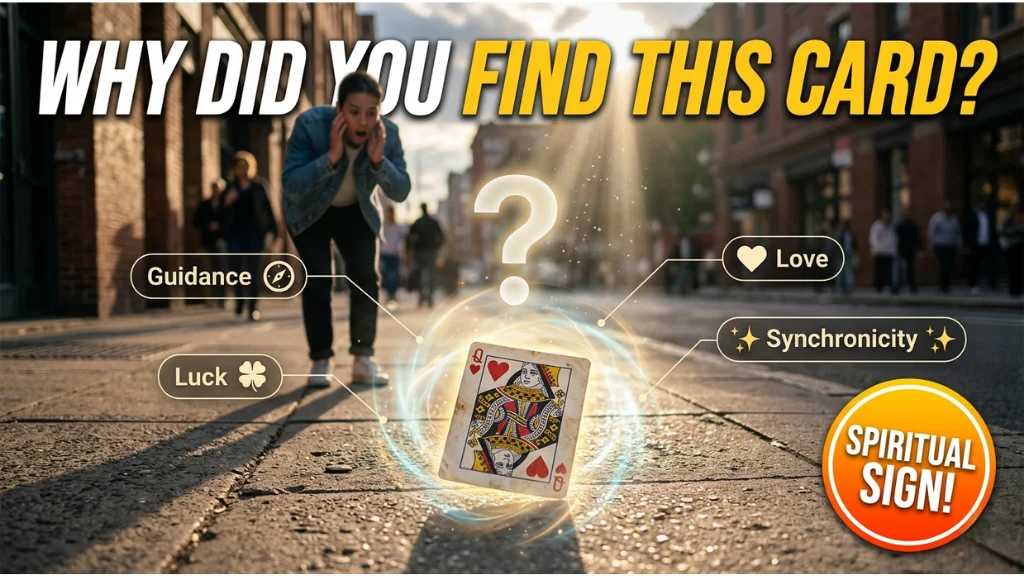
You step outside, and there it is. A single card, face up on the pavement. Maybe it’s the Queen of Hearts. Maybe it’s the Joker. Either way, something in you stops.
This guide breaks down the spiritual meaning of finding playing cards — what each suit, number, and face card represents, what position and color change, and what to actually do next. Every meaning here is grounded in real history and research, not guesswork.
Finding Playing Cards: Why It’s Never Really Random
Most people who experience finding playing cards describe the same thing: a small jolt of recognition. The card feels placed, not dropped.
Psychologists call this pattern-seeking instinct apophenia — the brain’s habit of finding meaning in random noise. It’s a real, well-documented tendency, and it’s worth knowing before you go further. But understanding the science doesn’t cancel out the experience. Many traditions have treated card omens as legitimate signals for centuries, and the practice has deep roots.
Playing cards themselves trace back to Tang Dynasty China. The earliest clear reference dates to 868 CE, when a Chinese princess was recorded playing a “leaf game” with paper cards (Wikipedia). The familiar Hearts, Diamonds, Clubs, and Spades weren’t standardized until French card makers settled on them around 1480 (The Met). Cartomancy — reading playing cards for divination — became a real profession a few centuries later, pioneered by the French occultist Etteilla, the first person on record to make a living reading cards (Wikipedia).
This isn’t a fringe interest today, either. A 2024 Pew Research Center survey found that 30% of U.S. adults consult astrology, tarot, or fortune telling at least once a year, and roughly one in ten consult tarot cards specifically (Pew Research). Finding a random playing card taps into that same long human habit of looking for signs in everyday life.
Must Visit:Yellow Birds: Symbols of Hope and Positivity in 2026
10 Spiritual Meanings of Finding a Playing Card
Once you know the basics, every card you find starts to carry a clearer message. Here are the most common spiritual meanings of finding a playing card, drawn from classic cartomancy and modern symbolic interpretation.
Guidance. A card appearing out of nowhere often works like a signpost. It points toward a decision you’ve been avoiding.
Synchronicity. Psychologist Carl Jung popularized the idea that meaningful coincidences aren’t random — they line up with your inner state. What does it mean when you find random playing cards? For many people, it means the outer world is mirroring something happening inside.
Warning. Not every card is good news. Some findings act as a nudge to slow down or notice a blind spot before it becomes a problem.
Fortune. Cartomancy has long used playing cards to glimpse what’s ahead. A found card can feel like a quick, unplanned reading.
Transformation. Spades and higher-numbered cards often show up right before a major life shift — a job change, a breakup, a move.
Validation. Sometimes a card simply confirms you’re on the right track. This is common when someone finds the same card twice, which feels less like chance and more like confirmation.
Choice. Discovering a card at a literal or figurative crossroads often lines up with a real decision waiting to be made.
Connection. Plenty of people report finding a card right around meeting someone new — or finding the exact card that represents someone already in their life, like a Queen of Hearts after a first date.
Risk. Aces especially tend to invite a leap you’ve been putting off.
Luck. Beyond symbolism, many traditions simply treat a found card as plain good fortune — something worth holding onto.
Playing Cards Spiritual Meaning by Suit, Number and Face Card
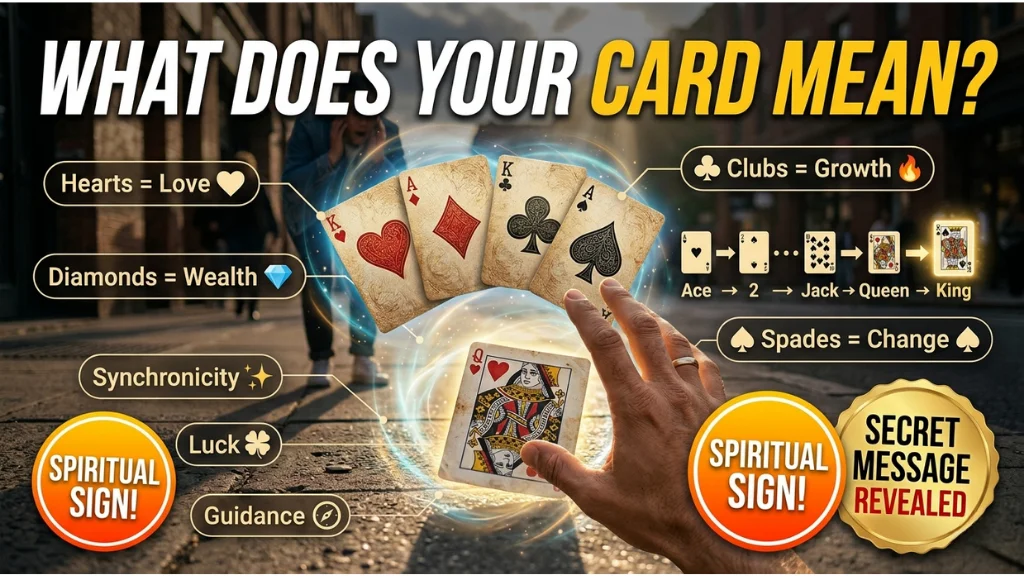
Reading a card accurately takes three pieces of information: the suit, the number, and (if it’s a court card) the face. Each layer adds detail to the message.
Hearts, Diamonds, Clubs and Spades: What Each Suit Reveals
The four suits map closely onto the four classical elements and Tarot’s Minor Arcana suits — a connection scholars have traced for centuries.
Hearts link to Water and Tarot’s Cups. They point to emotional matters: love, healing, or a relationship needing attention.
Diamonds link to Earth and Tarot’s Pentacles. They speak to your material world — money, career, and security.
Clubs link to Fire and Tarot’s Wands. They represent ambition, growth, and new projects gaining momentum.
Spades link to Air and Tarot’s Swords. They’re often misread as bad luck, but they really point to necessary change and hard truths.
Number Meanings: From Ace to Ten
Numerology adds another layer. Each number from Ace through Ten carries its own vibration:
- Ace — new beginnings
- Two — choice or partnership
- Three — early growth
- Four — stability
- Five — disruption
- Six — harmony after conflict
- Seven — reflection and insight
- Eight — power and ambition
- Nine — near-completion
- Ten — a full cycle ending
Face Cards and the Joker: Spiritual Archetypes
Court cards represent people or traits entering your story. The Jack signals youthful, restless energy. The Queen points to intuition and quiet authority. The King represents leadership and responsibility. The Joker, tied to Tarot’s Fool, is the wildcard — it shows up when life is shaking up your plans for your own good.
Birth Cards: Your Personal Card in Cartomancy
Cartomancy also assigns everyone a birth card, calculated from your date of birth, similar to a numerology number. If the card you find matches your own birth card, many readers treat it as an especially strong, personal sign rather than a general one. This system comes from the same 18th-century French cartomancy tradition Etteilla helped popularize.
Card Position, Color and Location: What They Reveal
The card itself is only half the story. How and where you find it changes the meaning just as much.
Face Up vs Face Down
A card lying face up delivers a clear, immediate message — something to act on now. A card face down suggests the message is still forming, still hidden beneath the surface.
Red Card vs Black Card Meaning
Older cartomancy traditions often treat red cards (Hearts and Diamonds) as a “yes” — favorable and encouraging. Black cards (Clubs and Spades) lean toward caution or a problem worth addressing. It isn’t a universal rule, but it’s a consistent thread across European fortune-telling history.
Does Card Condition Matter?
A worn, faded card suggests a long-building message — something that’s been trying to reach you for a while. A crisp, new-looking card points to a fresh, urgent sign meant for right now.
Where You Found It Changes the Message
A card on the street speaks to your public life: career, reputation, your next move. A card inside your home points inward, toward family or private emotions. Finding the same card more than once, especially in different places, raises the stakes — the message has stopped whispering and started insisting.
How to Read a Playing Card You Just Found
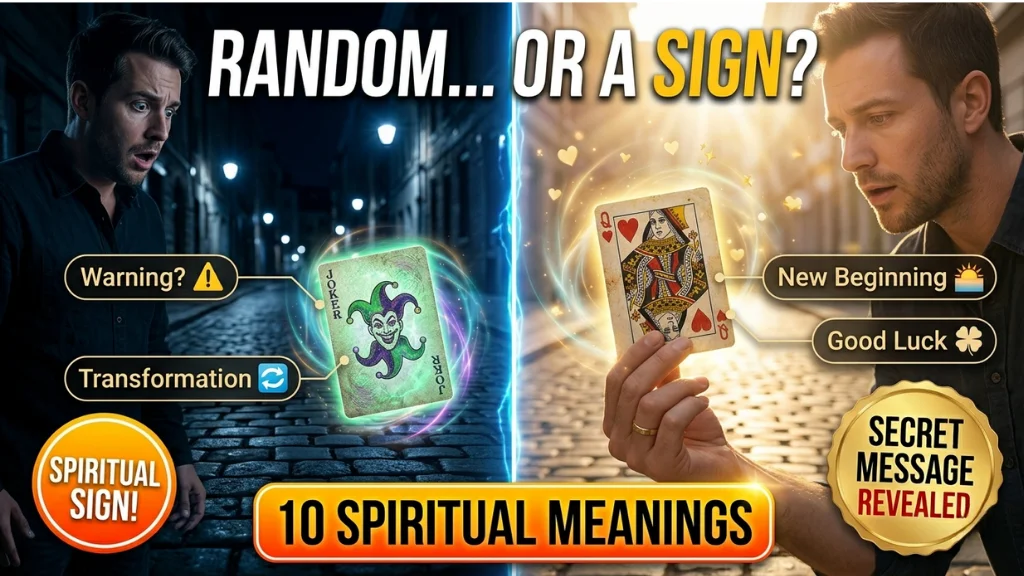
Don’t overanalyze it on the spot. A simple, grounded approach works better.
Pause and notice what you were thinking the moment you saw it. Pick it up if it feels meant for you. Record the suit, number, position, and condition. Then check what’s happening in your life right now that matches the suit’s theme.
If you find multiple cards together, read them as one combined message rather than separate signs — in the order you found them. And if two different people find the same card around the same time, many traditions read that as a shared signal, often pointing to a connection between them.
Keep a short journal of every card you find, along with the date and what was going on in your life. Over time, the pattern usually says more than any single card ever could.
FAQs About Playing Cards
What are the 4 types of playing cards?
The four types, or suits, are Hearts, Diamonds, Clubs, and Spades. Hearts and Diamonds are red; Clubs and Spades are black. French card makers standardized these four suits in the late 1400s, and they’re still used worldwide today (The Met).
How to tell someone’s fortune with playing cards?
This practice is called cartomancy. A reader shuffles a standard 52-card deck, lays out a spread (often three or seven cards), and interprets each card’s suit, number, and position to answer a question or describe a period in someone’s life. Modern cartomancy traces back to the French occultist Etteilla, who published the first card-divination guide in 1770 (Wikipedia).
What are the 13 different cards?
Each suit has 13 ranks: Ace, 2, 3, 4, 5, 6, 7, 8, 9, 10, Jack, Queen, and King. Multiply 13 ranks by 4 suits, and you get the standard 52-card deck.
How to memorize 52 playing cards?
Memory athletes use a technique called the memory palace, linking each card to a specific image and a fixed mental location. With practice, this method gets extremely fast — the current Guinness World Record for memorizing a full shuffled deck is just 13.96 seconds, set by Zou Lujian at the 2017 World Memory Championships (Guinness World Records). Beginners should start by grouping cards into sets of five and reviewing them daily.
Conclusion
Finding playing cards taps into one of the oldest habits humans have: looking for meaning in the everyday. Whether you treat it as synchronicity, simple psychology, or both, reading the suit, number, position, and place gives every card a clear story. Next time one turns up under your feet, you’ll know exactly how to read it.
Malik Sohail is the admin and author of ParensMeaning.com. He researches and writes clear, engaging content about spiritual meanings, symbolism, signs, and interpretations, helping readers understand deeper insights behind everyday experiences.