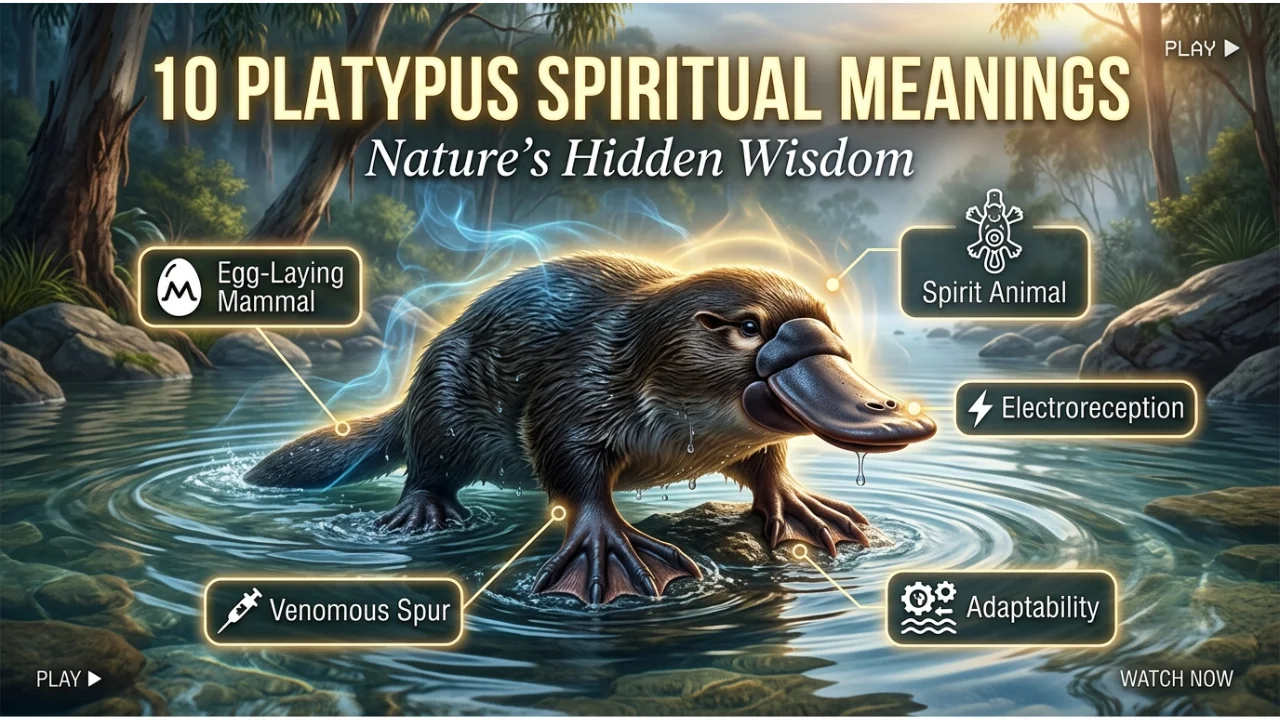
The platypus is one of the strangest animals on Earth. It lays eggs like a bird, swims like an otter, and stings like a scorpion. That mix of traits makes it a rare spiritual meaning symbol too.
This platypus guide breaks down what this animal means on a deeper level. You’ll learn the facts, the symbolism, and how to read a platypus sighting or dream.
What Is a Platypus? A Quick Look Before the Spiritual Meaning
A platypus is a small, semi-aquatic mammal found only in eastern Australia and Tasmania. It belongs to a rare group called monotremes — mammals that lay eggs instead of giving birth to live young. Only five monotreme species exist on the planet, and the platypus is the most famous one.
Its body reads like a checklist of borrowed parts. The bill is soft and rubbery, packed with electroreceptors that sense the tiny electric signals made by moving prey. The webbed feet push it through rivers and streams. Males carry a venomous spur on each hind leg, strong enough to cause severe pain in humans.
The platypus also glows a soft blue-green under UV light, a trait called biofluorescence. Scientists still don’t fully know why.
Because this animal blends parts from birds, reptiles, and mammals into one body, it has come to represent something bigger than biology. It stands for living outside categories.
Must Visit:Cockroach Symbolism: 10+ Insights on Strength & Growth
The Spiritual Meaning and Symbolism of the Platypus
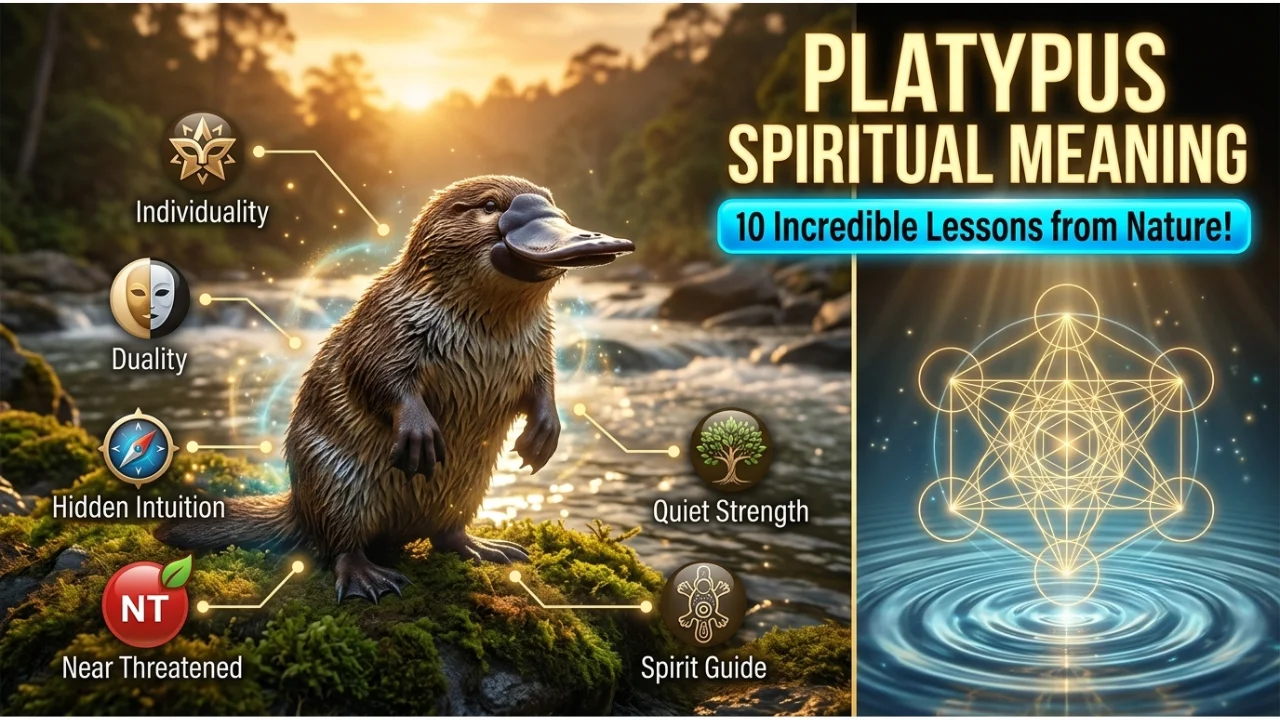
The platypus carries a message of paradox. It proves that two opposite things can exist in one being at the same time. This makes it a symbol for anyone who feels torn between different parts of themselves.
Here’s what it commonly represents:
Duality and balance — The platypus holds bird, reptile, and mammal traits together without conflict. It teaches that contradiction isn’t weakness; it’s wholeness.
Adaptability — This animal survives in water and on land, in daylight and darkness. It’s a reminder that flexibility is a form of strength.
Hidden intuition — Its bill senses prey through electric signals it cannot see. Spiritually, this reflects inner knowing — trusting a sense that goes beyond the five senses.
Individuality — No other living creature shares its exact combination of traits. The platypus symbolizes the courage to be one of a kind, even when the world wants a label.
Quiet strength — Indigenous Australian communities have long shown deep respect for this animal and the rivers it depends on, treating it as a sign of a healthy, living ecosystem.
Platypus as a Spirit Animal and Totem
When the platypus spirit animal shows up in your life, it often points to a season of contradiction. You might be holding two paths, two identities, or two emotions at once — and that’s okay.
People connected to platypus totem energy tend to be:
- Private — like the platypus resting alone in its riverbank burrow
- Intuitive — sensing situations before they’re obvious
- Adaptable — comfortable moving between different environments or roles
- Unconventional — uninterested in fitting a standard mold
Platypus in dreams usually points to something unresolved between two parts of your life — work and rest, logic and instinct, past and future. A calm river in the dream suggests peace with that balance. Murky or fast-moving water suggests the balance still needs work.
If a platypus keeps appearing in your thoughts, art, or conversations, take it as a nudge to stop forcing yourself into one box.
10 Powerful Spiritual Lessons and Facts About the Platypus
Each fact below pairs a real biological trait with the lesson it holds.
- Electroreception — The bill detects electric fields from hidden prey. Lesson: trust the sense you can’t explain.
- Egg-laying mammal — One of only five monotremes on Earth. Lesson: you don’t have to pick just one identity.
- Venomous spur — Males deliver venom strong enough to disable a human hand. Lesson: healthy boundaries protect your energy.
- Nocturnal and crepuscular habits — Most feeding happens at dawn, dusk, and night. Lesson: important work often happens away from the spotlight.
- Solitary burrows — Platypuses rest alone in tunnels along riverbanks. Lesson: solitude restores what constant company drains.
- Biofluorescence — Its fur glows blue-green under UV light. Lesson: there’s light in you that others may not notice at first glance.
- No stomach — Unlike most mammals, a platypus has no true stomach; food passes straight to the intestine. Lesson: simplicity works.
- Webbed feet, built for two worlds — Feet that swim in water and dig on land. Lesson: you can belong in more than one place.
- The puggle — A baby platypus, raised hidden in the burrow and fed milk through the mother’s skin, since platypuses have no nipples. Lesson: new beginnings often grow best out of sight.
- Near-threatened status — The platypus is now listed as Near Threatened, according to the IUCN Red List, with river habitat loss as a leading cause. Lesson: rare things need protecting, in nature and in yourself.
What Does It Mean to See or Dream of a Platypus?
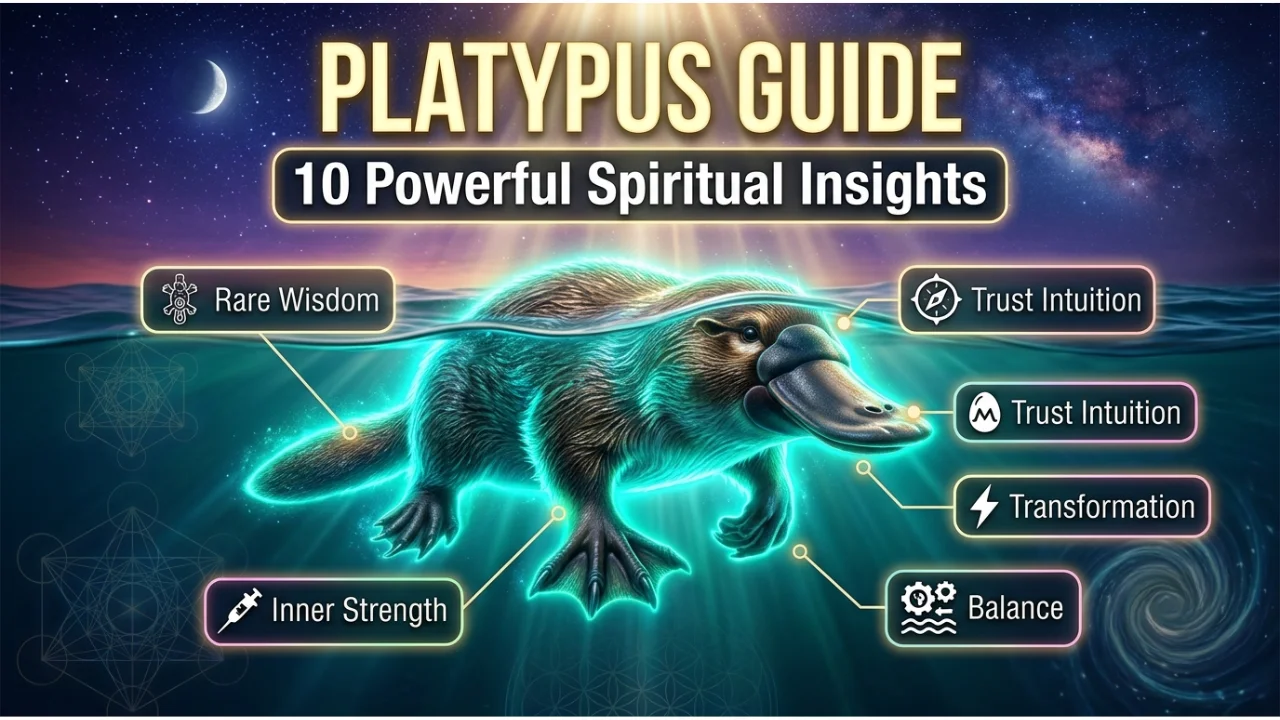
A real-life platypus sighting is rare. These animals are shy, mostly active at dawn and dusk, and easily disturbed by noise. Spotting one is often read as a sign that something rare or unexpected is about to enter your life.
In dreams, the meaning shifts with the water:
- Calm, clear water — steadiness and inner peace
- Murky water — confusion that needs sorting through
- A platypus swimming away — a sign to let go of something you’ve been holding too tightly
- A platypus stinging you — a warning to set a boundary you’ve been avoiding
Repeated sightings, whether real or symbolic, are usually read as a call to stop dividing yourself into pieces and start accepting the full, contradictory picture of who you are.
FAQs About Platypus Symbolism and Facts
What are 10 facts about platypus?
The platypus is an egg-laying mammal, uses electroreception to hunt, has a venomous spur, feeds mostly at dawn and dusk, rests in riverbank burrows, glows under UV light, has no true stomach, has webbed feet for swimming and digging, raises young called puggles, and is listed as Near Threatened due to habitat loss.
What is a platypus?
A platypus is a small, semi-aquatic mammal native to eastern Australia and Tasmania. It’s one of only five monotreme species in the world — mammals that lay eggs instead of giving birth.
What is the platypus famous for?
The platypus is famous for its strange mix of traits: a duck-like bill, a beaver-like tail, webbed feet, egg-laying, and a venomous spur. When it was first described to European scientists in 1799, many believed it was a hoax stitched together from other animals.
What are all the things a platypus can do?
A platypus can swim, dive, dig burrows, sense electric fields through its bill, lay eggs, produce venom, and nurse young through skin patches instead of nipples. It closes its eyes, ears, and nose underwater and relies entirely on its bill to hunt.
Final Thoughts
The platypus doesn’t fit neatly into any single category, and that’s exactly the point. It shows that contradiction can be a source of strength rather than confusion. Whatever brought this animal into your awareness, let it be a reminder: you don’t need to choose just one version of yourself.

Malik Sohail is the admin and author of ParensMeaning.com. He researches and writes clear, engaging content about spiritual meanings, symbolism, signs, and interpretations, helping readers understand deeper insights behind everyday experiences.